
With exercise, she regains the control PD takes away
Laurel Saville
The Upper Left, aka Pacific NW
Year of diagnosis: 2014. I was 51.
Exercise of choice: Over the various decades of my life, I’ve chosen activities that are both physically and mentally demanding. As a teenager, I wanted to ride horses, so I also worked in barns, mucking stalls and tossing hay bales. In my 20s, I got into martial arts, and in my 30s I started mountain biking and snowboarding. My 40s and 50s added hiking, backpacking, and camping.
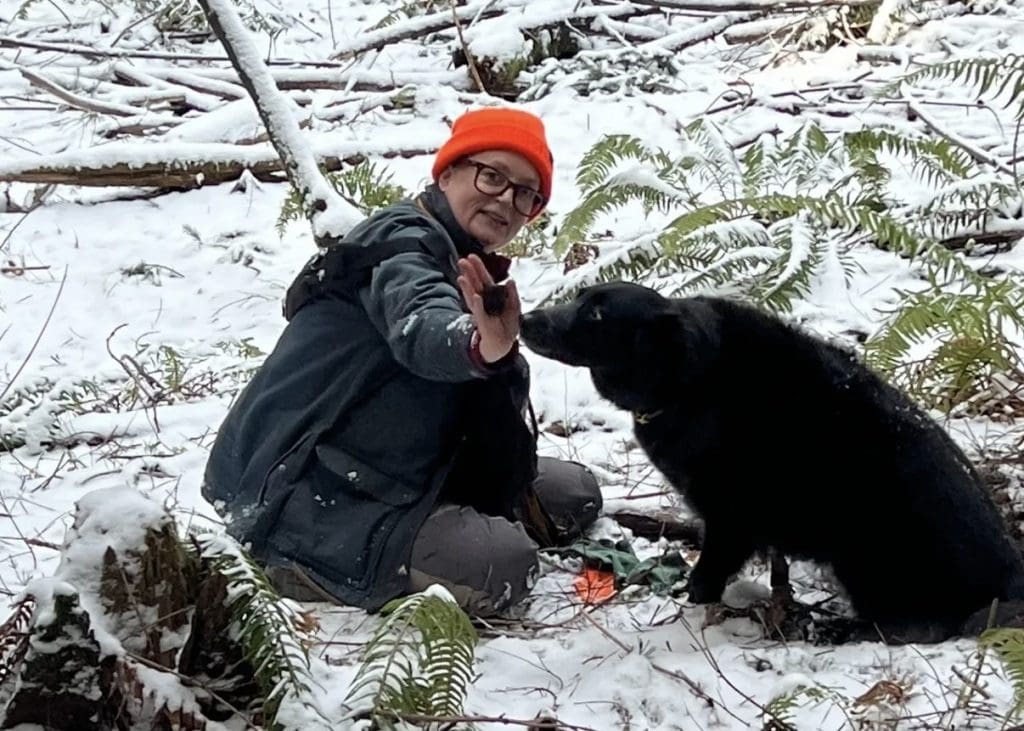
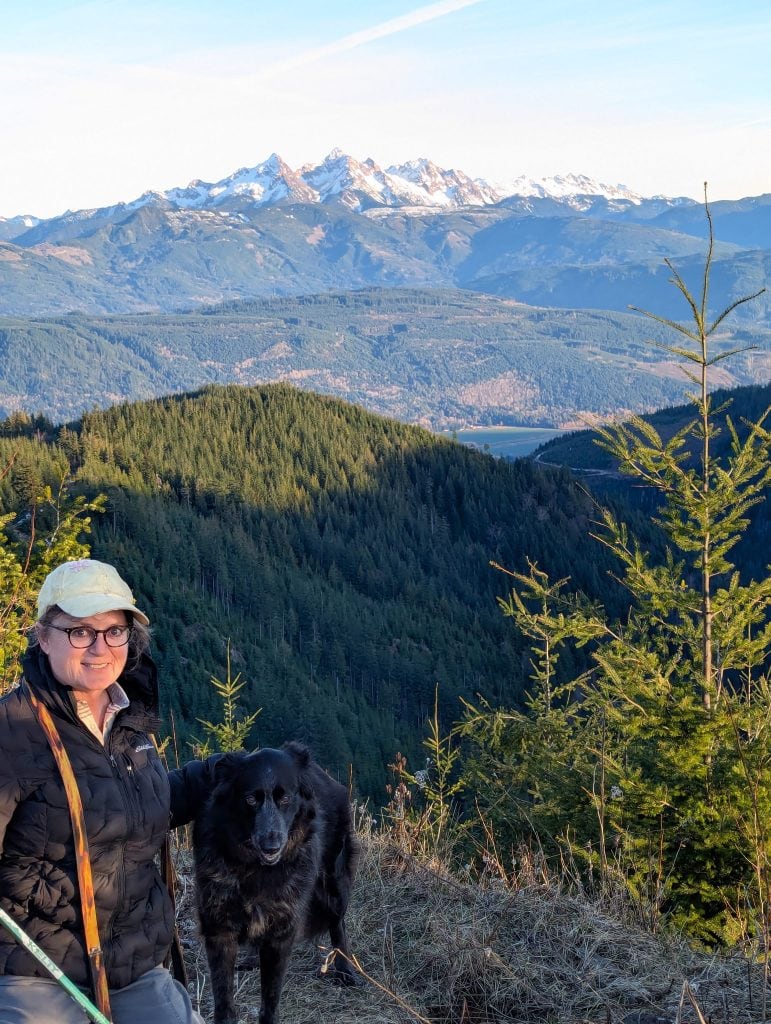
These days, my primary exercise is landscaping, caring for my 2.5-acre nature paradise, and hiking beautiful forests with my dog, Willow. I love foraging wild foods and have trained her to find truffles. I always supplement these outdoor activities with stretching, calisthenics, and weights.
Favorite place to hike: I live in the far NW corner of Washington State, where I am surrounded by stunning natural landscapes from the sea to the mountains. I don’t feel comfortable traveling anymore or driving more than a few hours, so I feel very fortunate to have such an interesting and inspiring outdoor playground all around me.
Toughest hike and why: So many come to mind, all for different reasons. I volunteered on a scientific study of wolves and feral dogs in the Abruzzi Mountains of Italy when I was in my early 20s. The principal investigator was well over 6 feet tall and very challenging to keep up with, especially when he took a tracking collar and challenged us to find him using our hand-held antennae, paper maps, and beginner triangulation skills. I climbed Africa’s Mt. Kilimanjaro, and the final push to the 19,341-foot peak took a lot of encouragement from the guides. When I lived in the Northeast, I hiked in the Adirondack Mountains. While they are not that high, the geography and trail system demand a lot of stubbornness, as getting to the top often requires a very long slog on a relatively mild ascent, followed by steep scrambles to the top.
I guess I’d say the biggest challenge a hike has given me was more mental than physical, and it was the first time I did a solo, three-day backpacking trip for my dog and me. I remember fretting over the guidebooks, wondering if I’d get from here to there in the time they noted, would I be able to get my tent put up, was I bringing the right gear, how would my dog handle everything, what if I got turned around or took the wrong trail? (This was before mapping apps were available.)
And the most fundamental point, would I make it? I was a woman in my early 50s, recovered from breast cancer, recently diagnosed with Parkinson’s, alone on a mountain, following a trail I’d never been on before. But this was something I’d wanted to do, and I didn’t know how much longer my physical health would allow this kind of adventure. So, I pushed through! I’ll always remember the elation and relief I felt when I made it all the way back to my truck. I did it! And my dog and I went on to have many more backpacking and camping adventures together, too
Most proud of related to outdoors: I think I’m most proud just that I keep at it. No matter where I’ve lived, or what I’m going through, I always find a way to get out into the woods.
Outdoor or exercise gear that is a must: My dog, Willow.
Advice for someone recently diagnosed who wants to stay active: Push back against the forces of PD, but also let go gracefully of the things you can’t do anymore. When I feel my shoulders start to pull in towards my chest, I go stand in a doorway with my forearms against the jambs, and step forward with my body, so my shoulders are pushed back where they belong. When my gait bogs down, I skip or march or stamp my feet on the ground to wake up my legs and remind them what they can do. When I no longer felt comfortable or safe peddling or paddling, I got rid of my mountain bike and kayak.
Because “comparison is the thief of joy,” I didn’t want to keep seeing these regular reminders of what “used to be.” Passing on the gear I could no longer use to someone who can considerably reduces the sting of waving goodbye to that part of my life and identity and allows me to focus on the many things I can do and really enjoy.
Advice for someone with PD who is just starting to exercise: Parkinson’s takes bodily control away from us; exercise gives it back. It doesn’t matter what you do, just do something. Then do that thing a little harder, or faster, for short intervals. This is the way to become better, stronger, more aware of and in control of your body and your disease. Measure progress by the only relevant metric, which is from where you started to how far you’ve come, not by what anyone else is doing.
Biggest challenge with Parkinson’s right now: Getting enough rest and sleep is always a challenge. I have REM behavior disorder, which messes with my sleep on top of the usual PD disruptions to circadian rhythms, and the aches and pains and weird sensations that make it difficult to get your body to rest. Managing the sometimes unpredictable highs and lows of medication efficacy is another constant challenge.
And I sometimes get dyskinesia around my mouth which has me licking my lips constantly and speaking too fast. Annoying.
But the biggest challenge of living with PD, I think, is trying to explain the why and what I can and can’t do. “You can tromp for hours through the forest but not through a Saturday crowd at the farmer’s market? You can shovel mulch and weed your garden all afternoon but need three days of rest to recover from a large dinner party? You can barely shuffle across a room in the morning but can go truffle hunting in the afternoon? Well, you look fine to me!!!”
PD is such a quirky disease. I often say it’s a software, not a hardware problem, which is why you can’t point to the place that “hurts,” and why you can be strong, fit, flexible, athletic one minute and completely gummed up the next – we have buggy software!
I just wish it wasn’t so hard to explain and get empathy for our lived experience with PD. The effort to help others “get it” can strain friendships and other relationships.
How I try to stay positive: I don’t try to stay positive. I’m a realist. Some days it sucks. Some days it’s not so bad. Feelings are not positive or negative to me. They’re just feelings and I let them come and go, share whatever information is useful to me at the time, and move through it. I’m also fortunate that gratitude comes naturally to me. I don’t have to reach for it. Accessing gratitude is a simple way to feel better.
Career field: I have been a writer, author, brand communications consultant, and, late in life, somewhat accidentally and unwillingly, I have become a part-time dog behaviorist. My two worlds have recently collided in a new book of essays I wrote, “How to Live with a Dog: Stories about humans with dog problems and dogs with human problems,” available in May 2026.
_________________
If you have Parkinson’s and the outdoors and exercise are part of your life, you could be featured in Unshakable Voices, too. Email unshakablehiker@gmail.com.