
My views, lots of news from WPC 2026
PHOENIX, Ariz. – I had the privilege of attending the World Parkinson Congress 2026, which is now history.
Because not everyone could attend this sold-out mega-event, I decided to blog about important things I learned, interesting people I met, and cool things I saw during the week. All in not-quite-real time.
Take a look and see if anything interests you. As always, I encourage your comments and questions below. Ready? Set. Go!
May 24, Day 1
Sunday, 12:15 p.m.
It’s great to be here
We’re checked into our downtown Phoenix hotel. Jon, the Unshakable Husband, and I are here for the four-day World Parkinson Congress, held every three years in different places for patients, care partners, doctors, researchers and advocates.
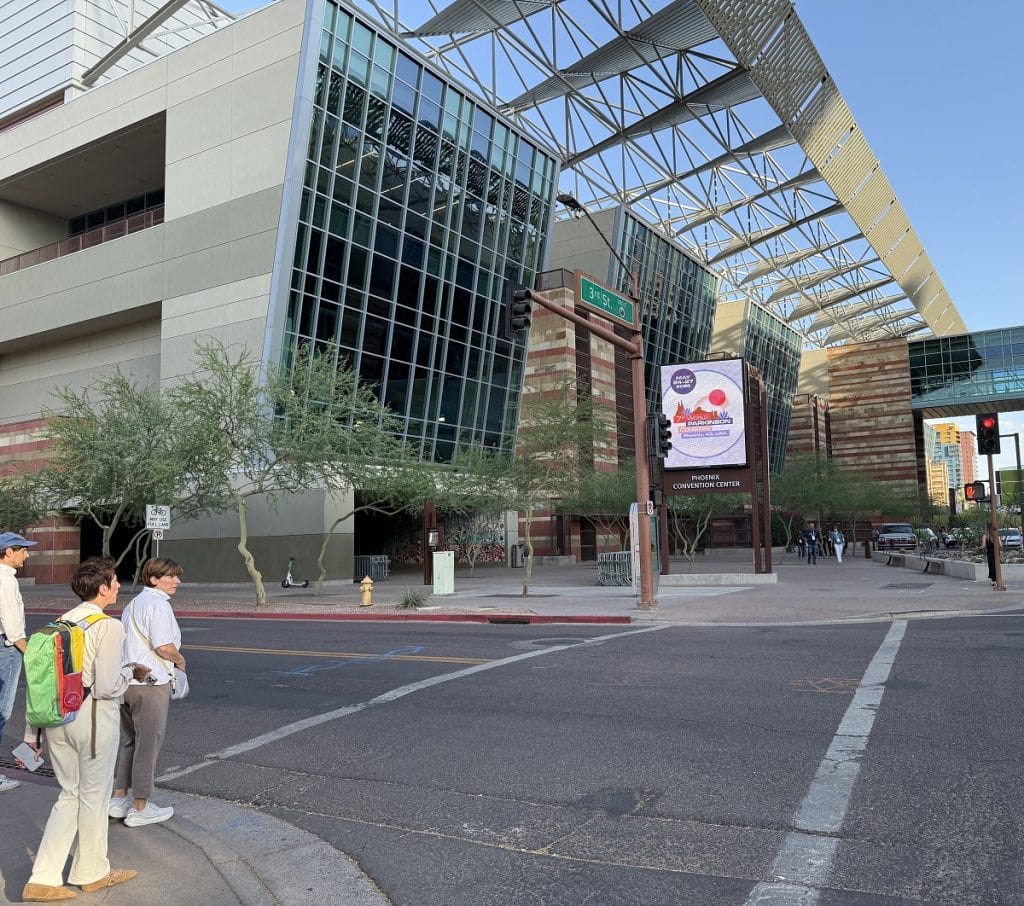
The extraordinary lineup of speakers and sessions fills a 166-page program booklet.
I’m definitely jazzed.
Sunday, 3:50 p.m.
Paddle sports galore
The first day is called “Pre-Congress” and is basically and add-on for early bird attendees who pre-booked their activities. There are extra sessions to choose from, plus pickleball and ping pong tournaments. Jon and I couldn’t resist the chance to play pickleball, and we signed up for the tourney with a few dozen others.
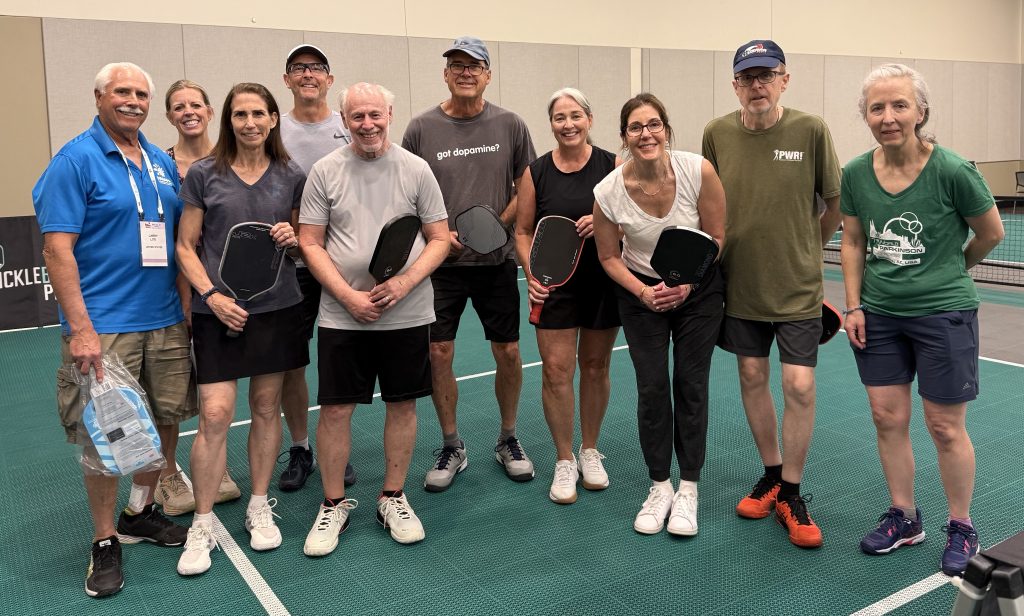
Here’s where we met the Addisons, a delightful couple who traveled across an ocean from their home south of London. They are among 150 volunteers here to make things run smoothly for the nearly 4,000 conference participants.
The Addisons told me about a new sport spreading in Britain as fast as pickleball has in the U.S. It’s called “padel” and it’s like racquetball, except the walls are glass and the ceiling is open. It’s been disconcerting for Britain’s tennis crowd to see their courts being converted.
Sunday, 7:50 p.m.
A grand opening
An auditorium full of people got a little history of the WPC, which began 20 years ago with organizers saying, “I don’t know if this will work, but the community is ready.” That’s what WPC’s president, Roger Barker, said during the opening ceremony tonight. That first congress in 2006 brought together an unprecedented group and began awakening the world to a disease that was still in the shadows.
At the opening ceremony I learned I am among two-thirds of the 3,930 delegates attending WPC for the first time. We are from 62 countries.
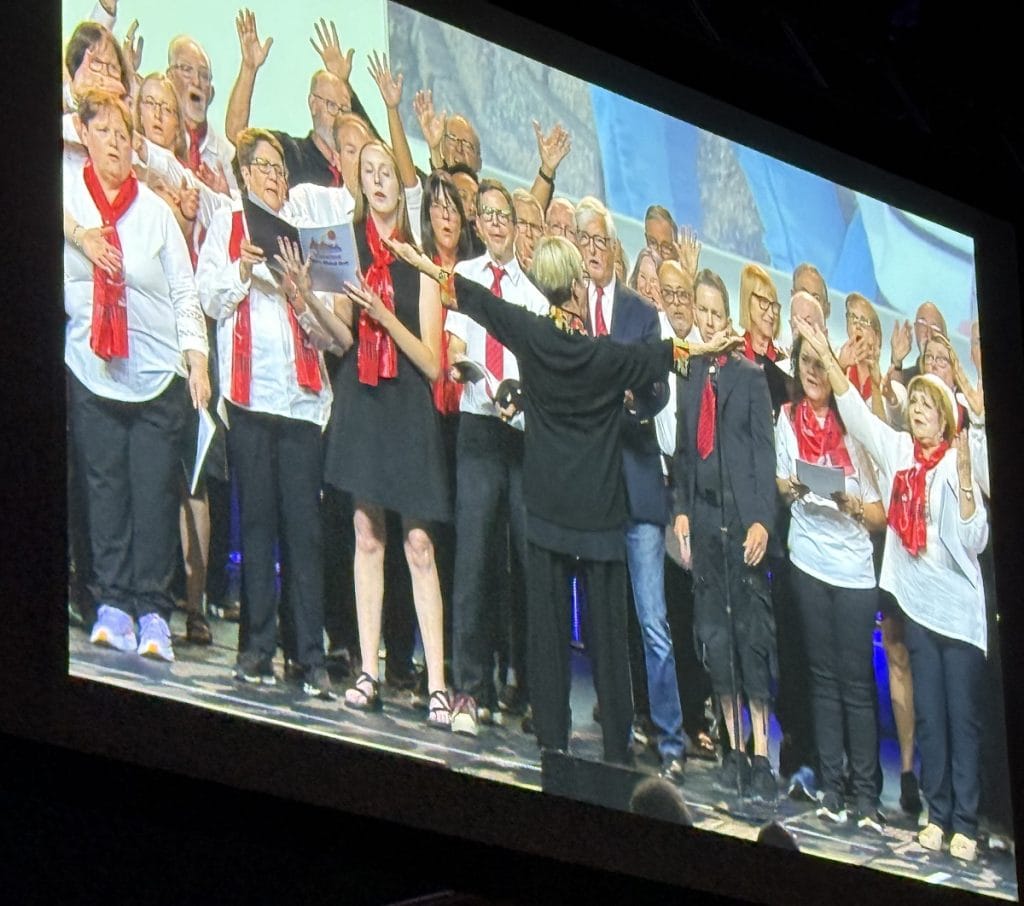
The ceremony was both touching and entertaining. It included talks, stories, videos, song, dance, and virtual visits from several celebrities like Julie Andrews and Carol Burnett.
Sunday, 8:30 p.m.
Feelin’ the love
I left the auditorium and followed as the audience walked en masse toward the exhibition hall, where we’d get a preview of products and services available to people with Parkinson’s (PwP).
Then the green-shirted volunteers gave us all a surprise. As we were corralled down the hallway, they lined up along both walls and clapped and cheered for us. It felt quite nice to be supported, like we were marathon runners or something.
In a way, we kind of are.
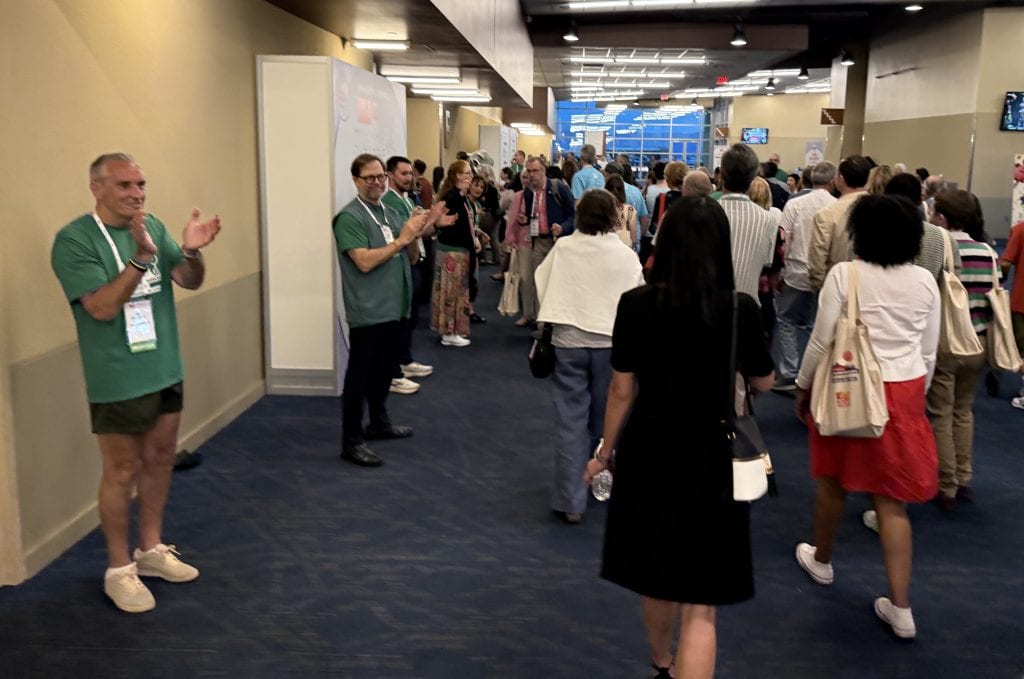
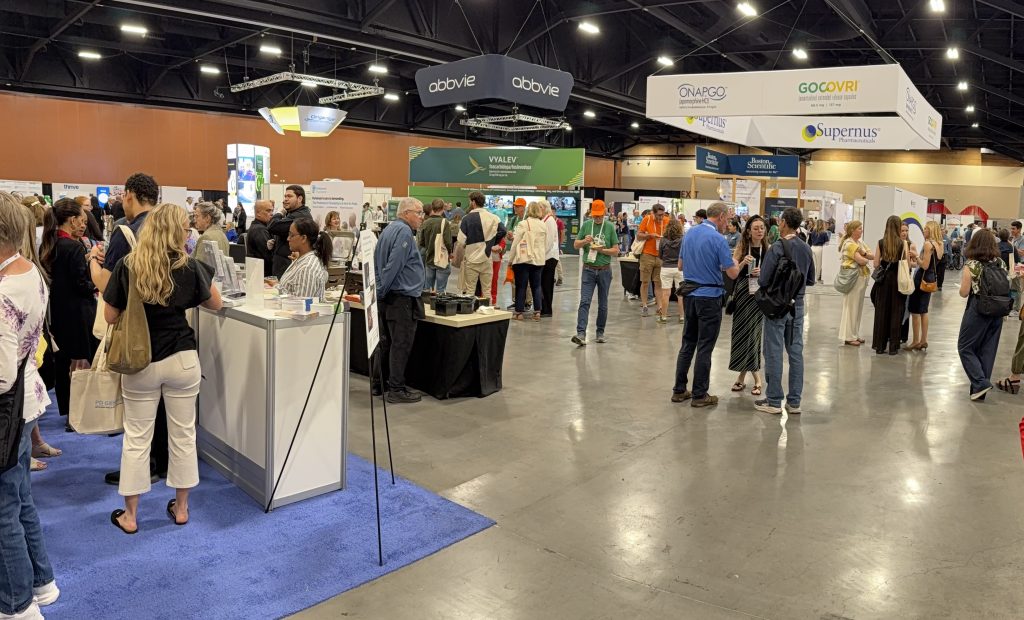
In the exhibition hall I found a few people I know through this blog and through social media; it was exciting to meet them in person.
Jon and I grabbed some snacks, which was more like a light dinner, and as I sat at one of the tables and started talking to others, I noticed something was different.
Typically, when dining out with others, I do my best to keep my leg from bouncing too much and I eat with my left, non-shaky hand to avoid the distraction of my symptoms. But here I make no effort to hide my erratic movements. Misery loves company? When in Rome? There must be a cliché for this!
May 25, Day 2
Monday, 6:45 a.m.
Keeping my routine
When I travel across time zones, it takes a day or two to switch my Parkinson’s meds to the new schedule. But that’s not the only routine that gets messed up. Exercise is harder to fit in when I’m busy and away from my neighborhood gym. And there was plenty of discussion about healthy lifestyles at the WPC to remind me that movement is a priority.
So I force myself out of bed and popped on down to my hotel’s fitness center. As usual, when the workout is done, the endorphins soared. Who needs dopamine to feel good all over?
Monday, 8 a.m.
Signs of interest
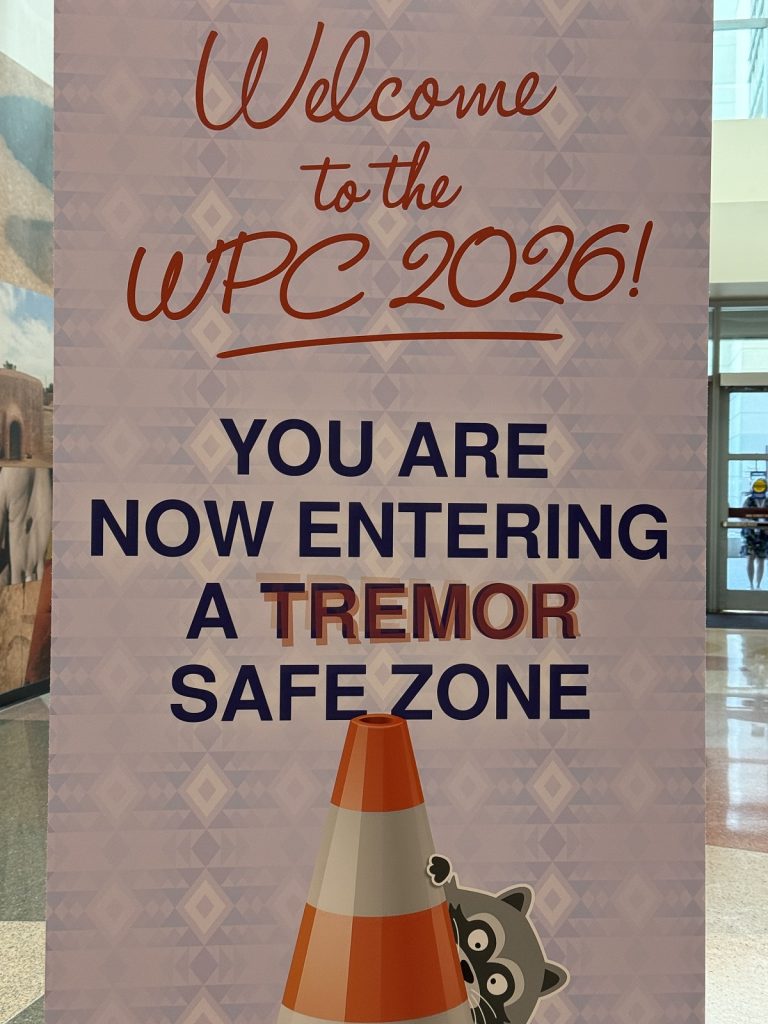
This reassuring sign greeted me this morning in the Phoenix Convention center at a major crossroad near the bottom of an escalator.
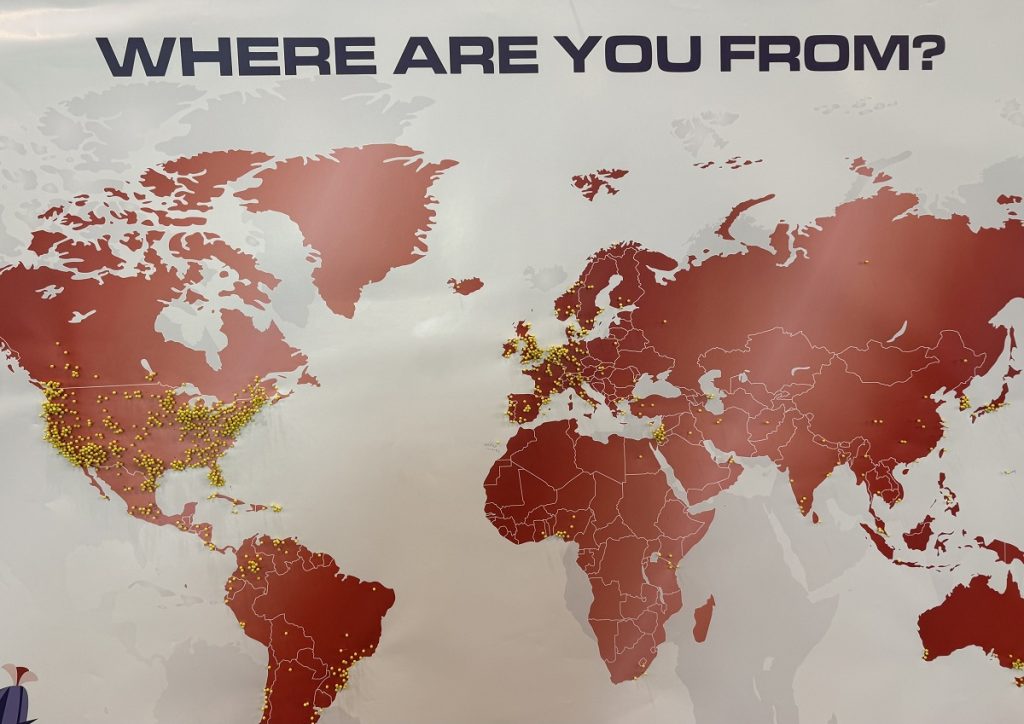
And this wall display allowed attendees to “pin” the cities and countries they came from.
Such global representation!
Monday, a.m. and p.m.
Hike prep
I spent time in between everything else getting people signed up and organizing the hike we are hosting early tomorrow morning.
Looks like we’ll have a crowd!
There was a last-minute blitz of interest, and we easily will fill the van and other cars that will take this group of lovely people to Papago Park to breathe some fresh desert air — before tomorrow’s high hits 97 F.
Monday, 11:40 a.m.
Connecting in person
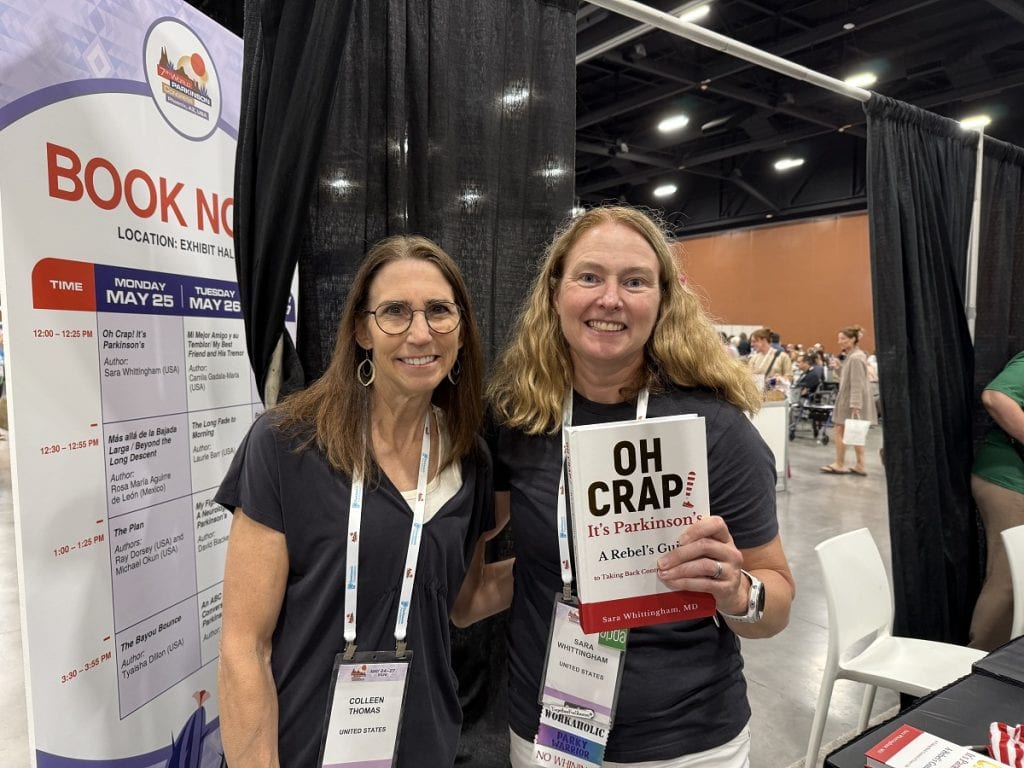
My friend Sara Whittingham held a book signing for her recently published “Oh Crap! It’s Parkinson’s.” We’d gotten to be online buddies over the past year, and finally we met in person! The book review I wrote is here.
Monday, 1:45 p.m.
Cells and imaging
I went to a couple of midday sessions. The first was on cell therapy. My biggest takeaway was the researcher’s comment about cell therapy and clinical trials, a sizzling topic right now. The trials that succeed are the ones that meet their end point. Those that don’t end up in the dustbins of history. It’s a huge gamble for pharma companies, which have to play their cards well.
The other session was a roundtable. I’ll point out the tables were rectangles, but they got the job done.
At the table I chose to join, a recognized expert got us up to date on PET and SPECT scans. It was all pretty technical.
Monday, 4:15 p.m.
Back in the paddle
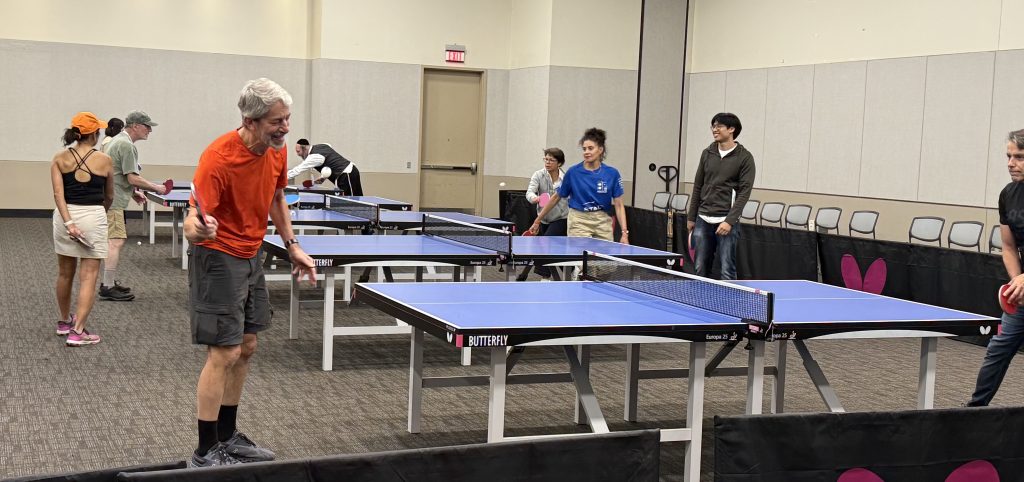
This time it was ping pong, and all it took for me to qualify for a Parkinson’s-only tournament was to, well, have had a Parkinson’s diagnosis!
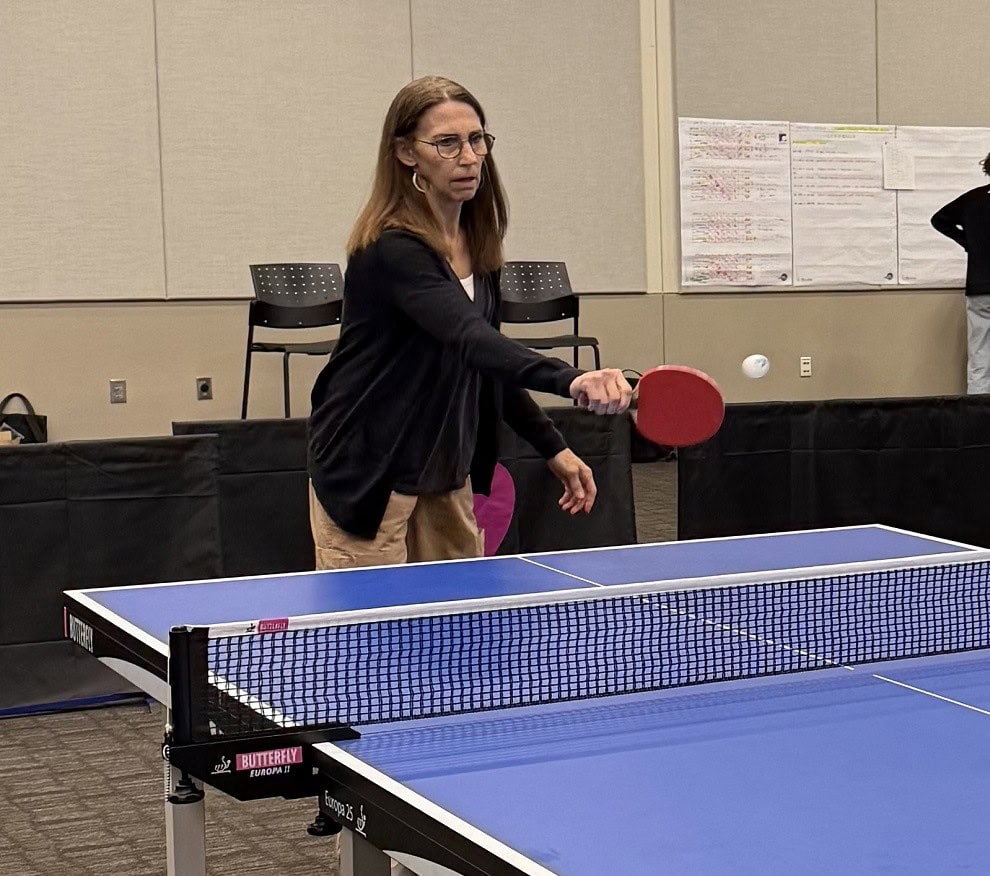
No proof was required.
According to an informational poster on the wall, early studies show ping pong can help PwP improve balance, coordination, visual and auditory processing, and decision making. And I have to add that it’s therapeutic in other ways; isn’t it satisfying to slam a high bouncer onto the table just out of your opponent’s reach?
Monday, 5:30 p.m.
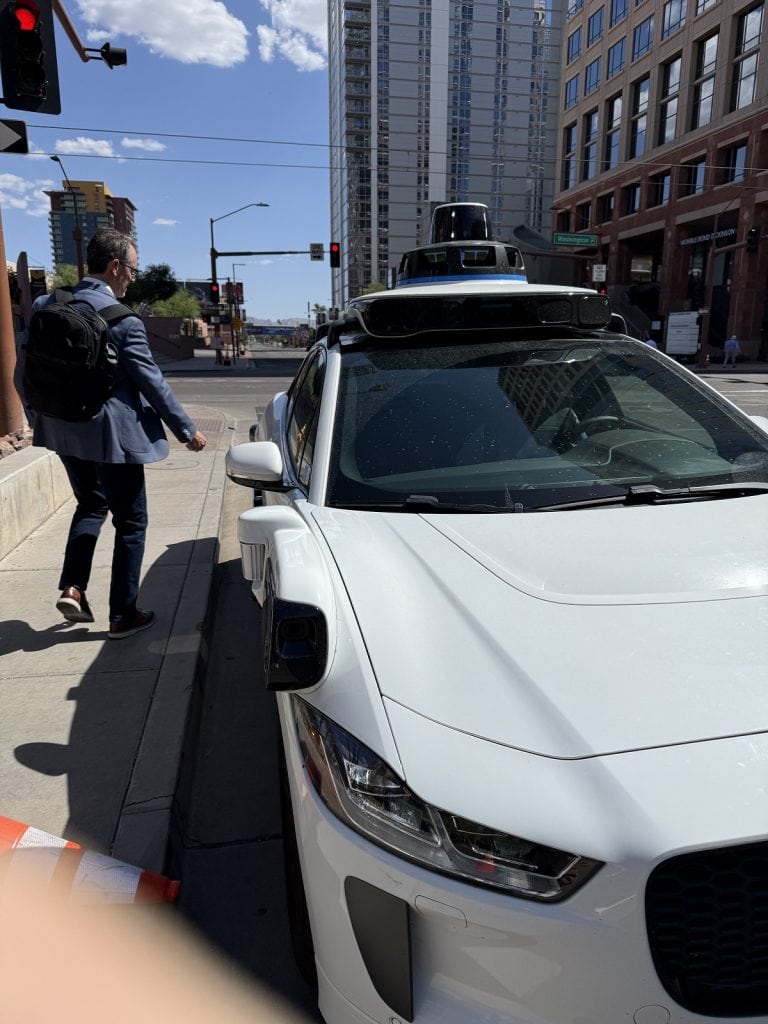
Look Ma, no driver!
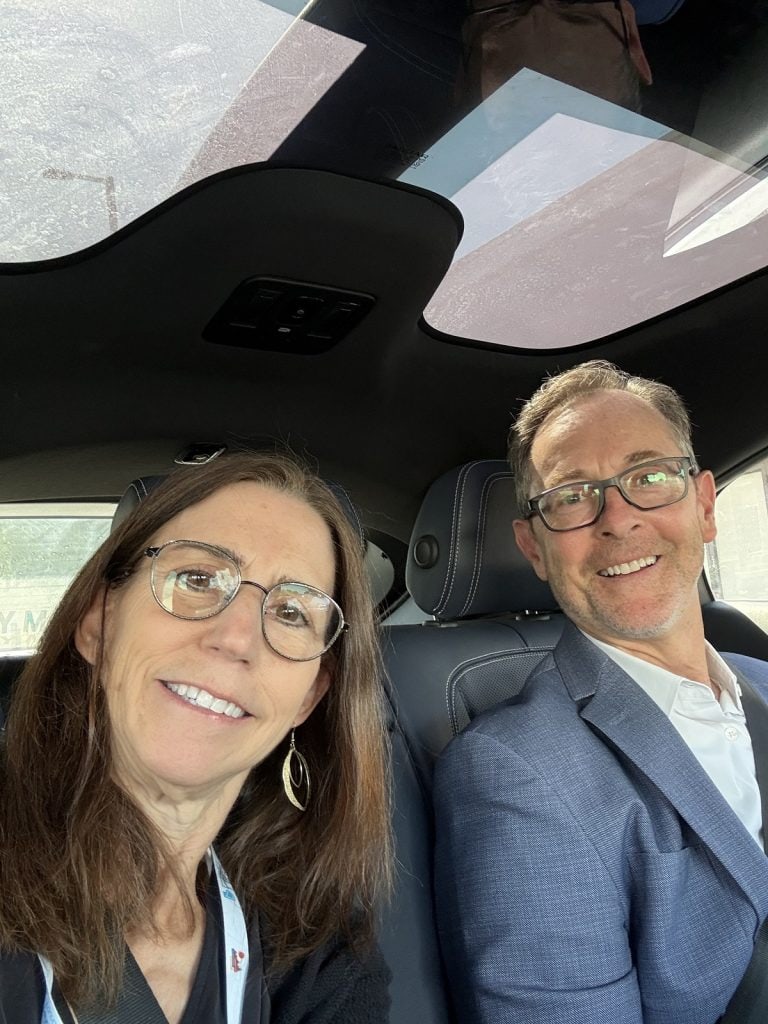
Jon and I took a Waymo for the first time when it was time to pick up the rental van for tomorrow’s hike. It was a 10-minute ride of wonderment. I videoed the entire thing. The self-driving cars are all over Phoenix and some surrounding towns.
May 26, Day 3
Tuesday, 5:45 a.m.
A good morning
We are up and at the place we chose for our hike check-in: the lobby at the Sheraton. It’s the hotel where a lot of the WPC participants are staying, and a couple dozen of them have signed up for the Unshakable Hiker’s first-ever group hike.
When Jon and I arrive, participants are already in line. The response is more than I could have hoped for. I am glad for even the late-comers who signed up just a few hours earlier, hoping there would be room for them in the van. There isn’t, but they share Uber rides to meet the rest of us at Papago Park in Phoenix, our hiking destination.
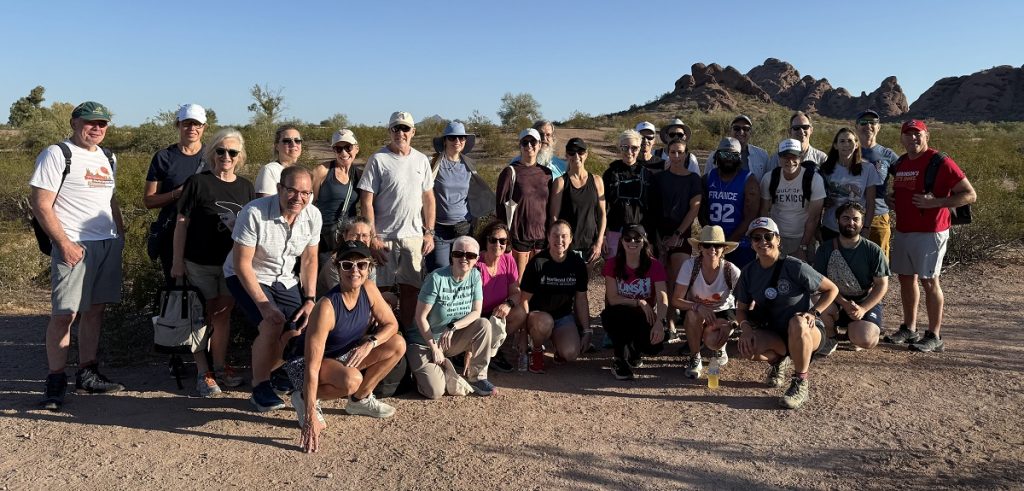
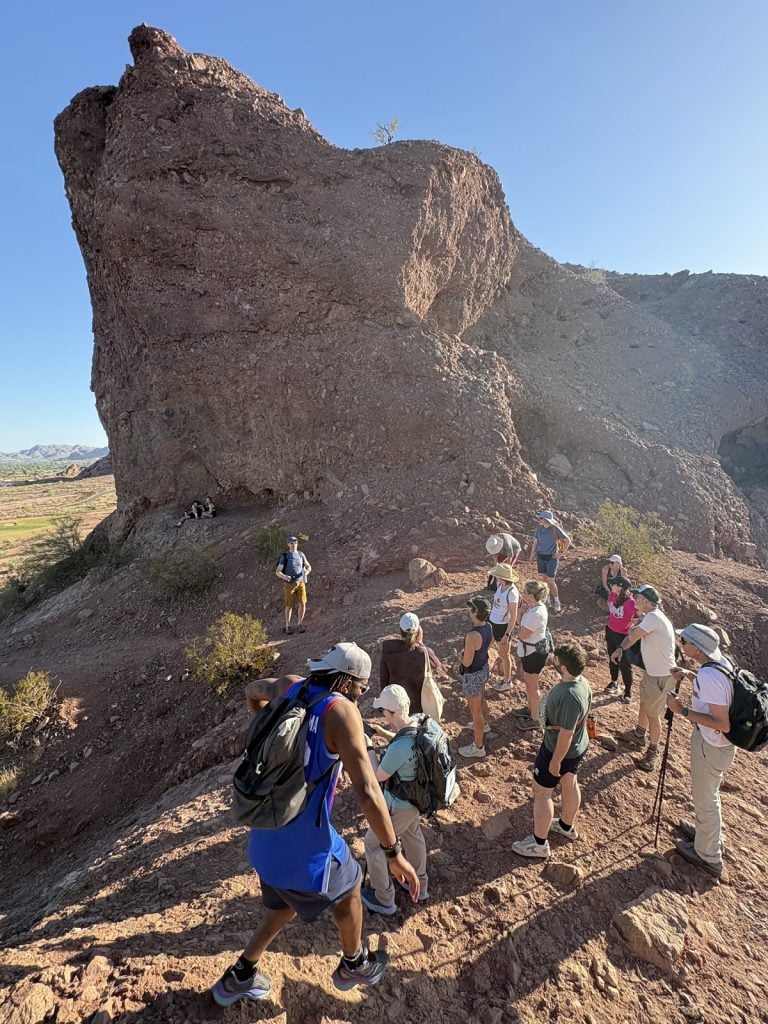
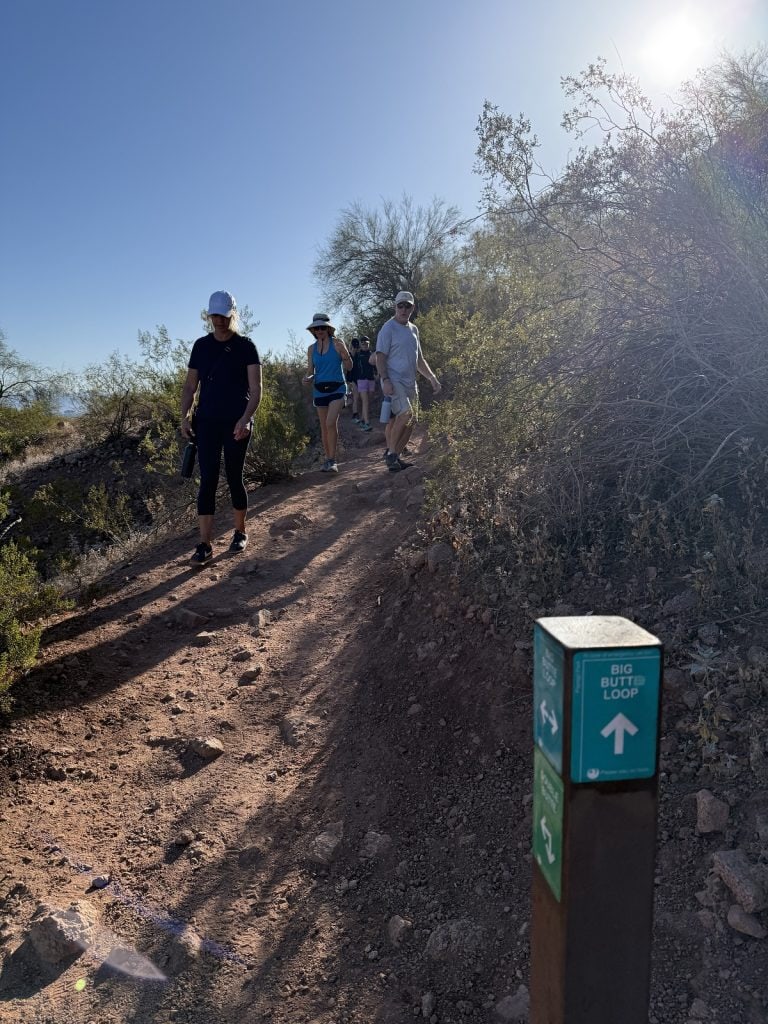
Once everyone arrives, hikers set off in groups, in pairs, or individually. They are from France, Scotland, New Zealand, Canada, Ireland, England, Sweden, and several states in the U.S. Among them are physical therapists, a civil engineer, PD advocates, two neurologists, book authors, an Air Force veteran, a nurse, and a CEO of a nonprofit. About half of the hikers live with Parkinson’s disease. It’s apparent everyone who came loves to hike!
Planning this event took months of work, but it made me happy to facilitate an invigorating start of the day for 30-plus outdoors enthusiasts.
(Photo below by M. Farrer.)
Tuesday, all afternoon
A little learning
A couple of sessions I attended gave me some things to think about.
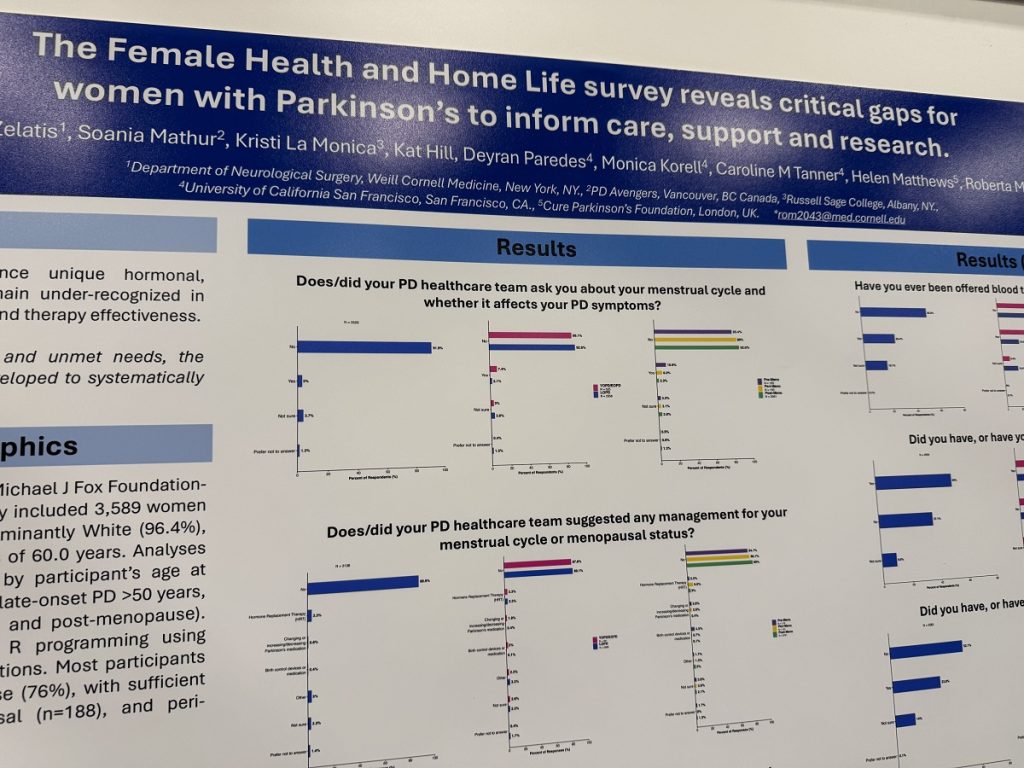
First, a poster session showed research on the needs, desires, and experiences of women as they navigate treatments for Parkinson’s. It identified major gaps in clinical care, declaring there are “unmet needs and barriers to discussion of hormone-related symptoms.”
The study surveyed 3,600 women with questions like “Does your team ask you about your menstrual cycle and whether it affects your PD symptoms?” I’ll be watching to see what happens as this topic finds its way into medical journals more often.
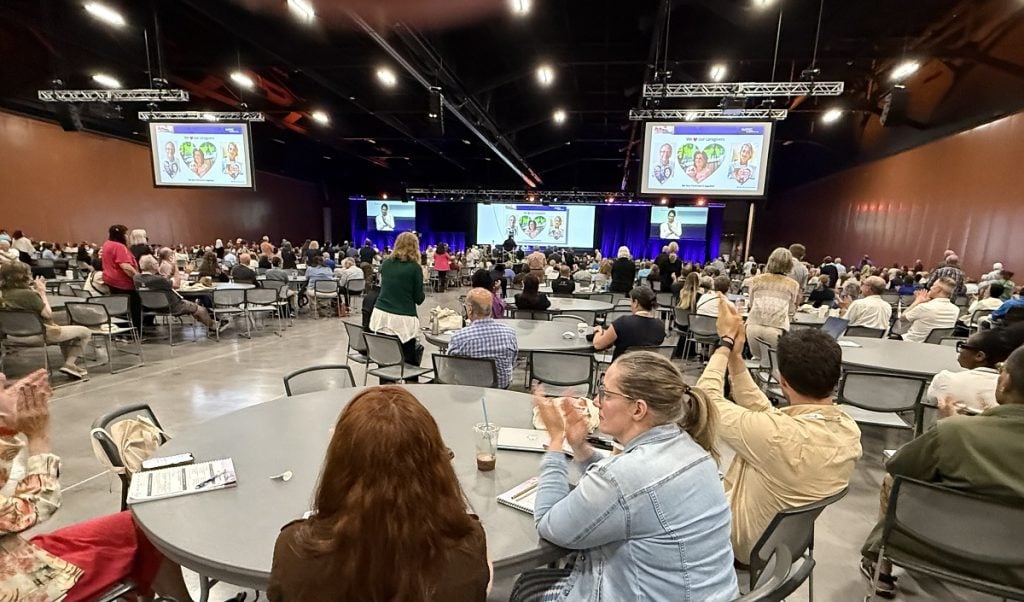
And here, at a plenary session, all care partners in the audience are asked to stand up to be recognized for their service that often goes unseen.
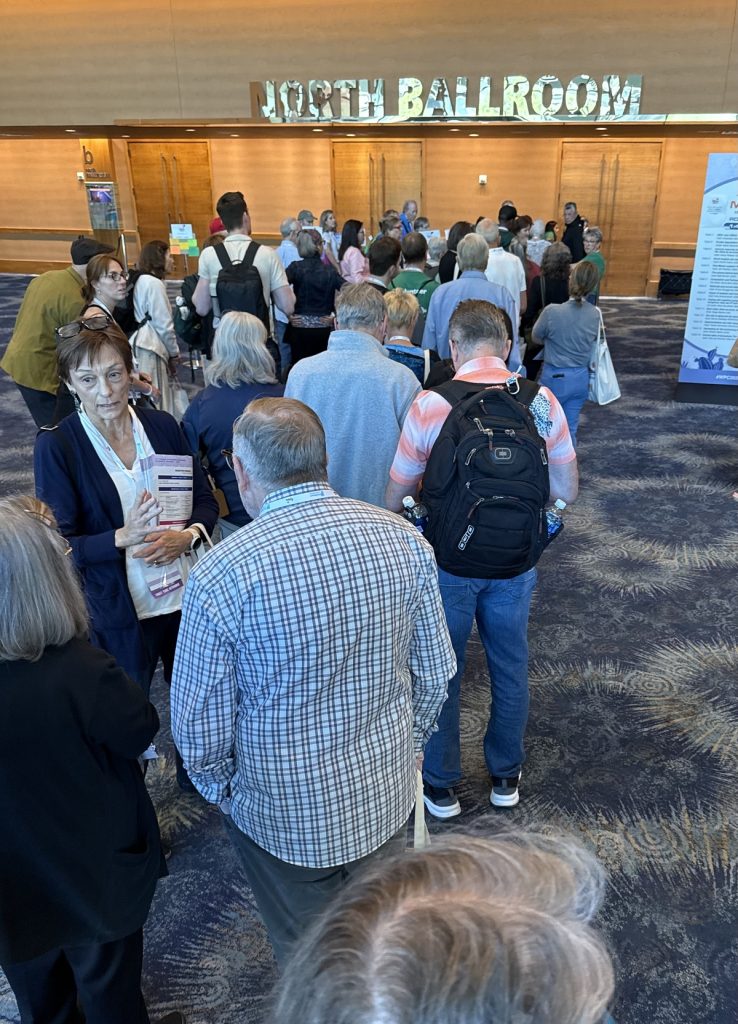
At the afternoon roundtable discussion sessions, some experts were a hot ticket.
People waited in line 45 minutes or more to be seated at certain tables.
I was fortunate to get a ticket with Roger Barker, a renowned pioneer in stem cell research for Parkinson’s.
He described several current clinical trials, some in the U.S., and he warned against “stem cell tourism.”
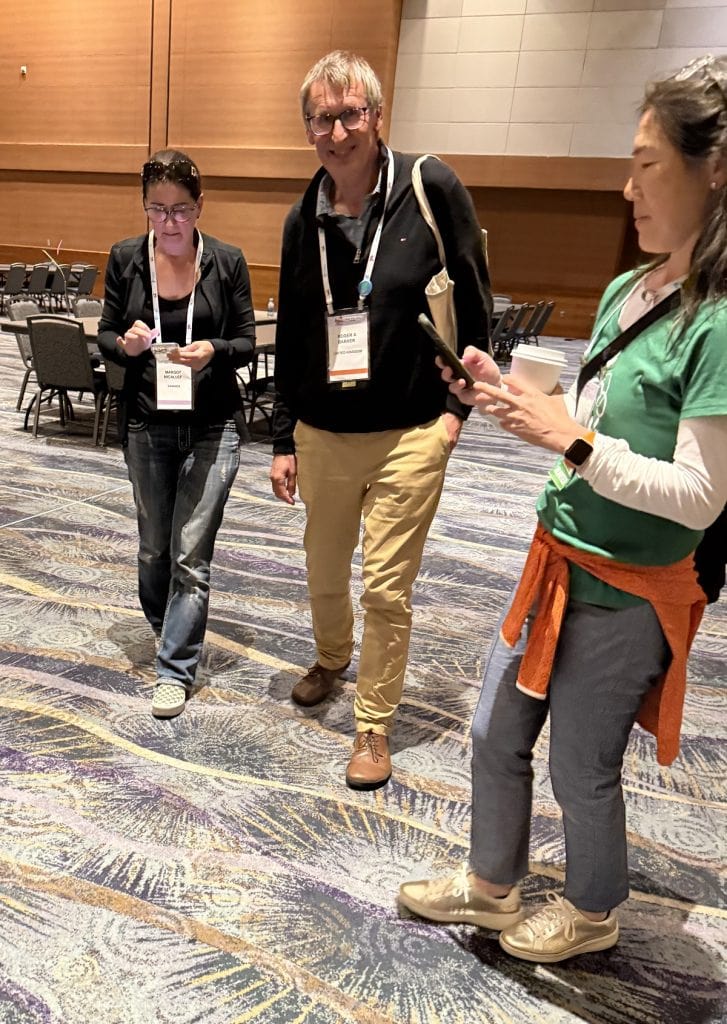
The man has a crowd around him wherever he goes.
Cell therapies seem to be dominating many sessions this year, and interest among PwP is growing.
May 27, Day 4
Wednesday, 8:15 a.m.
Social media connections
The triannual World Parkinson Congress is a once-in-three-years chance for people with PD to gather. But what fuels the world Parkinson’s community year round is social media.
Regular contributors who share their experiences with Parkinson’s have sprouted up on Instagram, TikTok, and other platforms. And many of those now-familiar faces were seen at the WPC.
One was Esther, shown below at left, who since her diagnosis three years ago has gone from novelty social media contributor to outspoken Parkinson’s advocate to policy-shaping delegate to Washington, D.C.
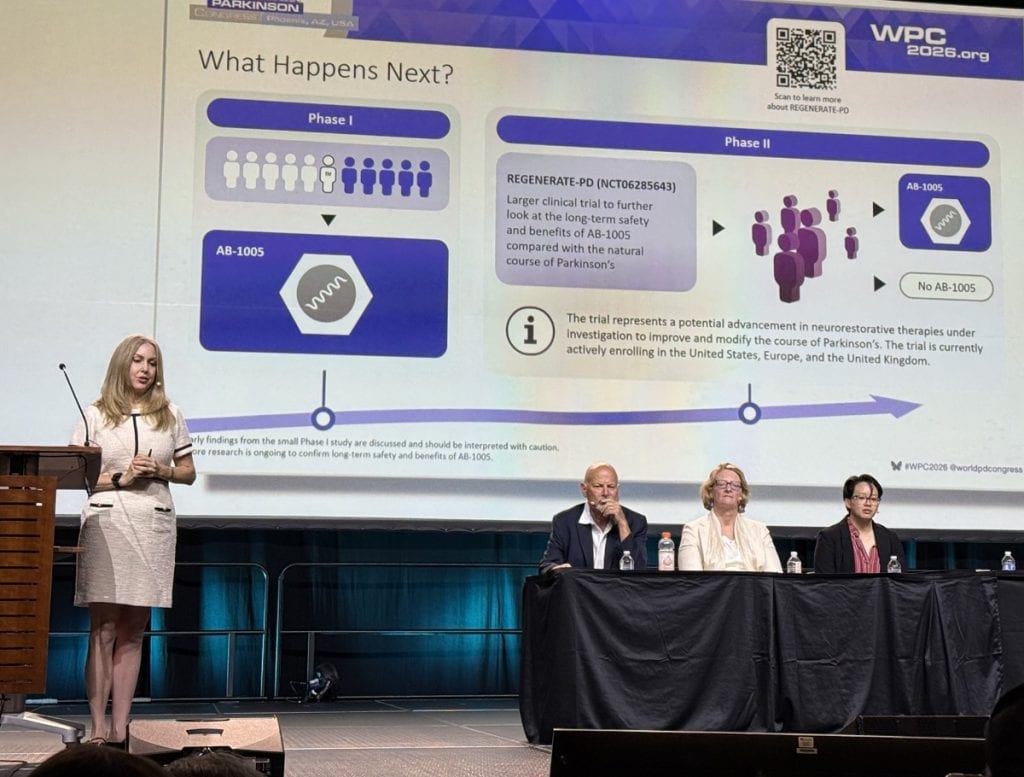
At this morning’s “Hot Topics” session, her job was to explain a complicated GDNF gene therapy, known as AB-1005, in a way that the average patient would understand it. Kind of like a medical translator.
Thanks to her talk, I’m sure I wasn’t the only person who walked away with a greater understanding of the new therapy.
Wednesday, 9:05 a.m.
Let’s move!
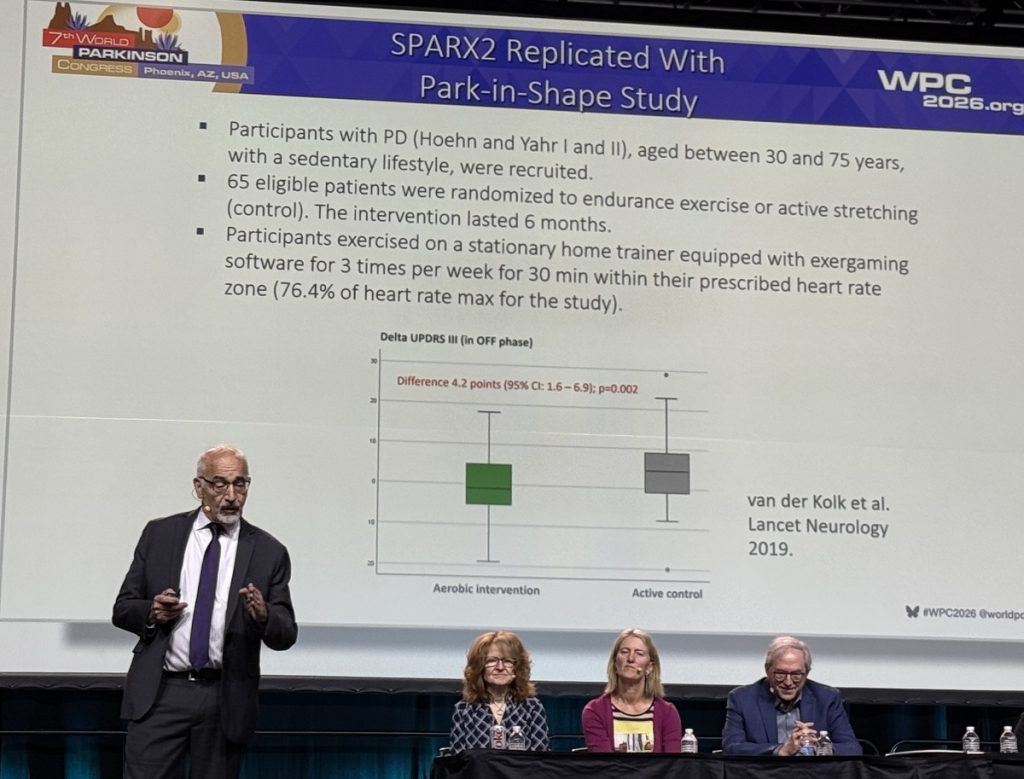
Exercise was front and center in the two-hour plenary session: the science, the benefits, the neuroprotection. Professor Daniel Corcos explained his previous studies that show certain types of exercise can slow progress of Parkinson’s. “The evidence is clear,” he says, and he – and the entire community – are eagerly awaiting results of his larger study, called SPARX-3. (I’ll be writing more about this in a future post.)
The final speaker was Jimmy Choi, American Ninja Warrior and a celebrity with this crowd and beyond. He was diagnosed at 27, and after eight years of being sedentary he decided to do something about his Parkinson’s.
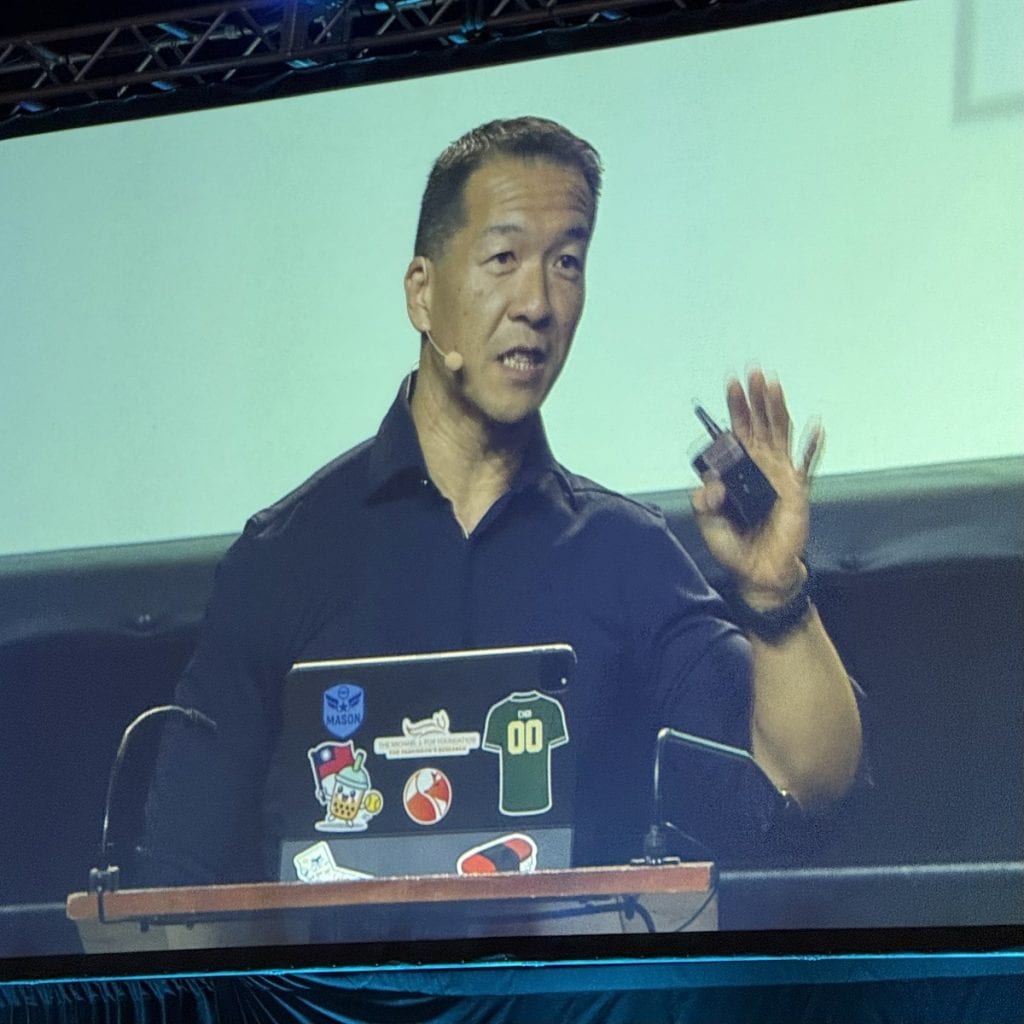
“All I knew was exercise made me feel better,” he said. “So I made my goals based on how I wanted to live my life.”
His story is inspiring.
Wednesday, noon
Women and Parkinson’s
Another big talking point among presenters at the conference was women’s experience with PD. There were sessions, panels, posters, and roundtables on the subject.
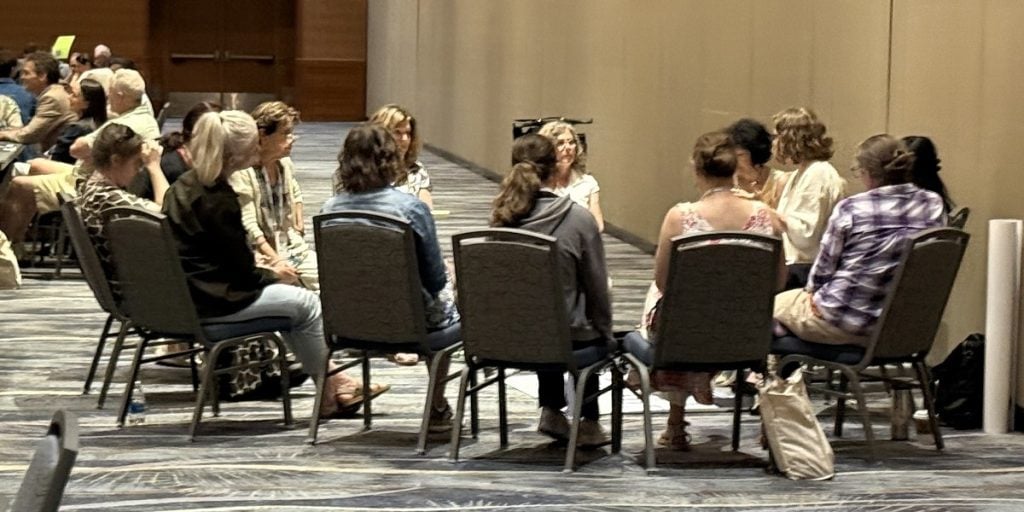
It doesn’t surprise me that the audiences for these events were mostly women – up to 80% or 90% from what I could tell.
Jon noticed he was in the super-minority at a panel today, called “Parkinson’s and Women.” He said it’s unfortunate there weren’t more men listening. “They need to hear these things, too,” he said.
Wednesday, 12:45 p.m.
Laughter as medicine
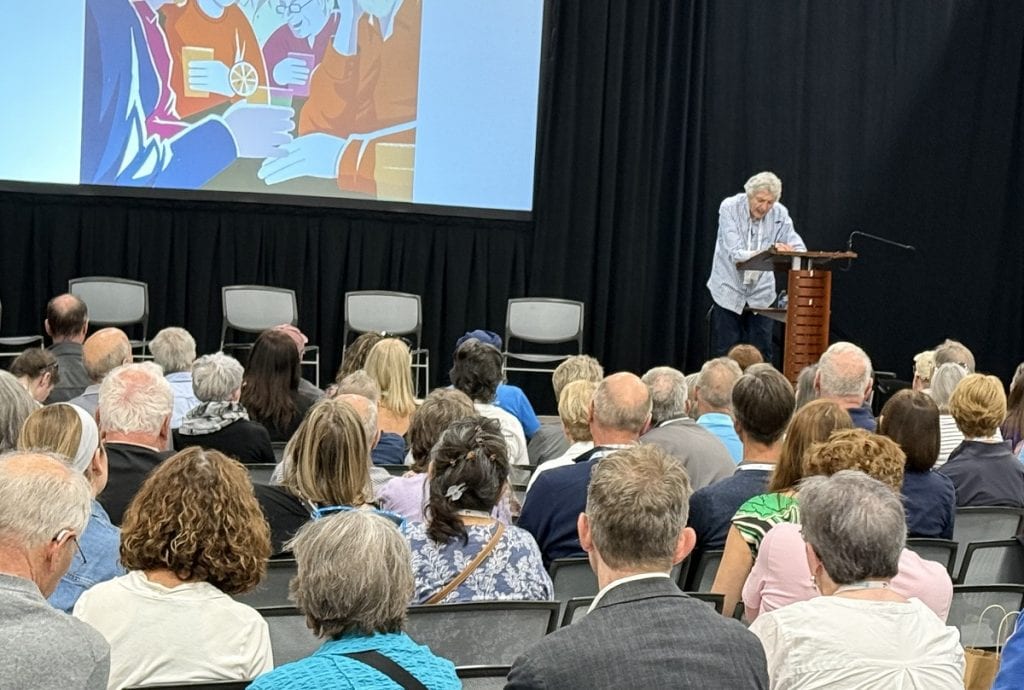
As a breather from all the seriousness of a neurological disease, a comic from the UK did a little stand-up routine to a standing-room-only lunchtime crowd.
He told about the time he fell for the first time and hit his head. His friend rushed him to the hospital. He recalled, “I always knew Parkinson’s was funny, but this time it had me in stitches!”
Wednesday, various times
Meeting people
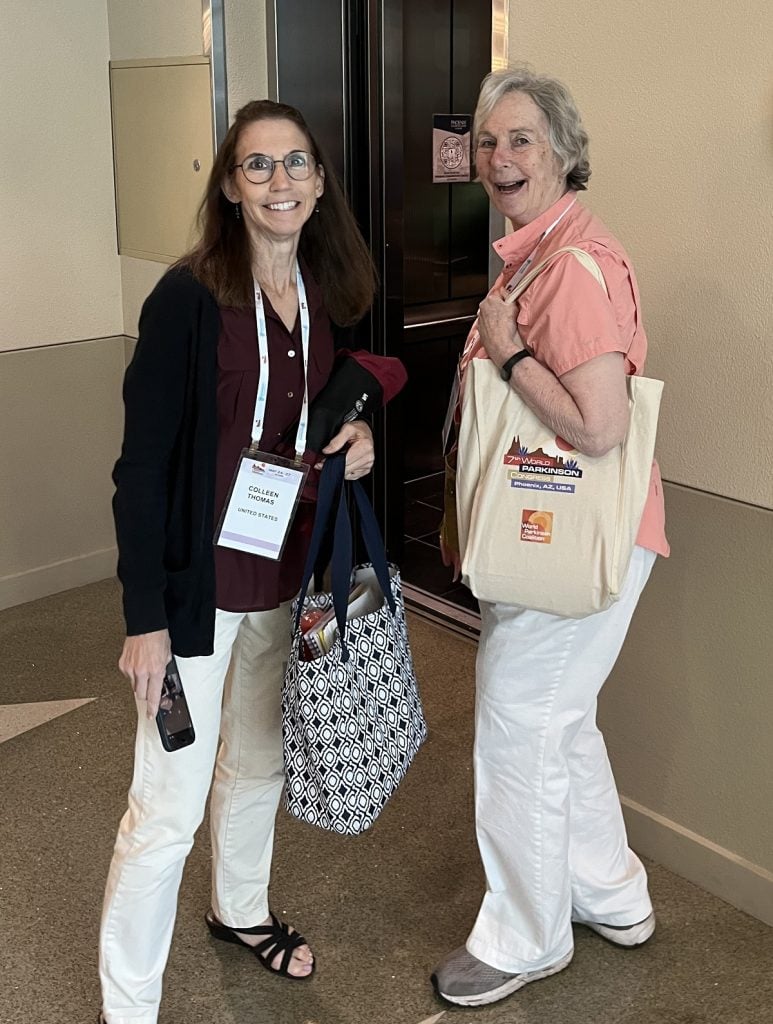
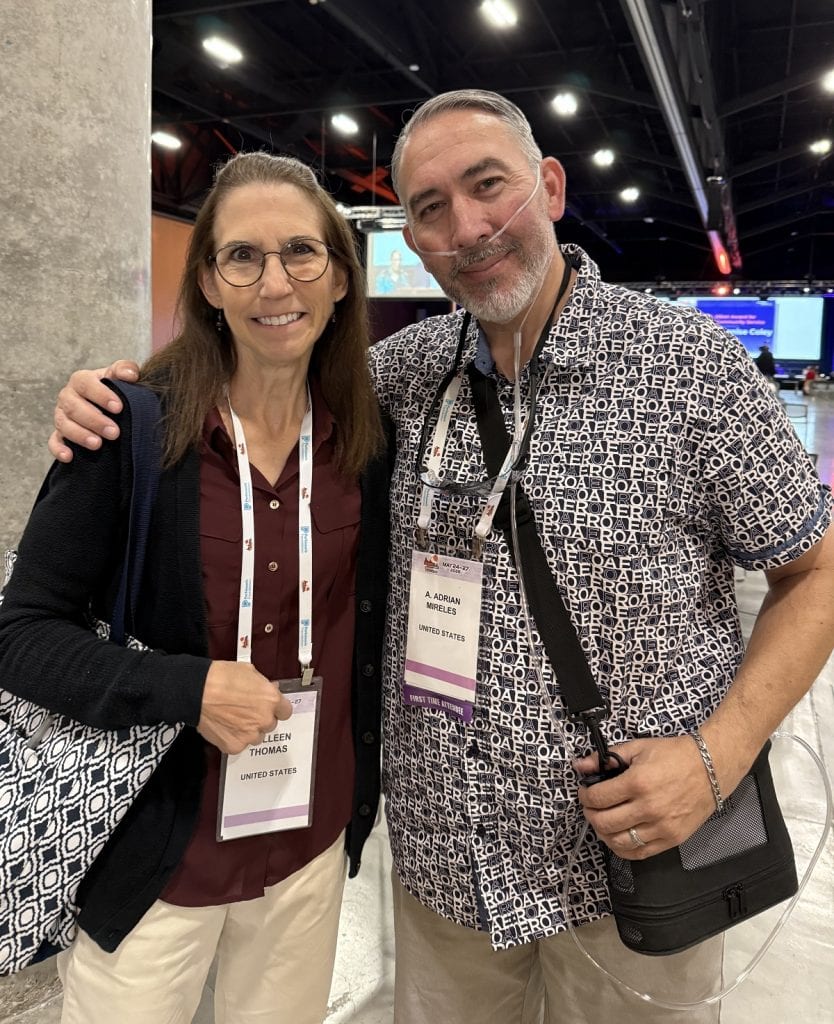
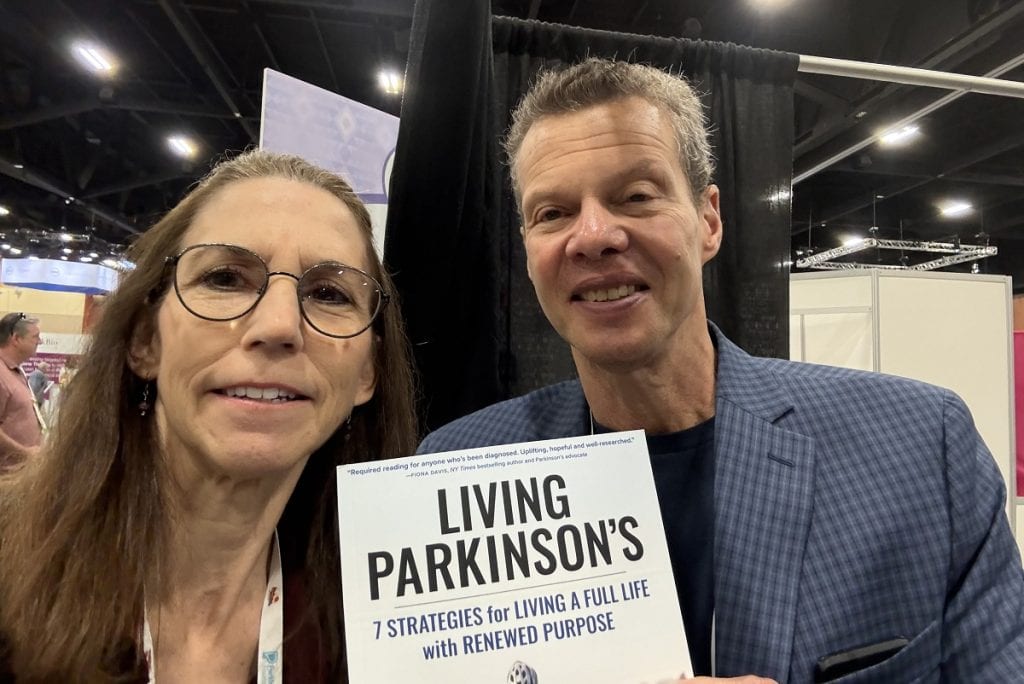
I ran into friends from online contacts and my support group at home, and I made new friends, too.
Final thoughts
It’s time to reflect, and look ahead, too.
The World Parkinson Congress has something that most professional medical conferences do not: patients and caregivers in attendance. It is purposefully set up to give doctors, researchers, advocates, and businesses a clear picture of what’s important to PwP. It also was a unique opportunity for me to learn what’s out there in the field so I can be better advocate for myself.
As a patient, I found it amazing to be sitting at a table with or at the feet of hard-working and very smart people who have become big names in Parkinson’s research, knowledgeable doctors who treat us, and leaders of nonprofits backing us. Knowing they are listening gives me hope – for future prevention, for a cure or reversal, and for a more fulfilling life.
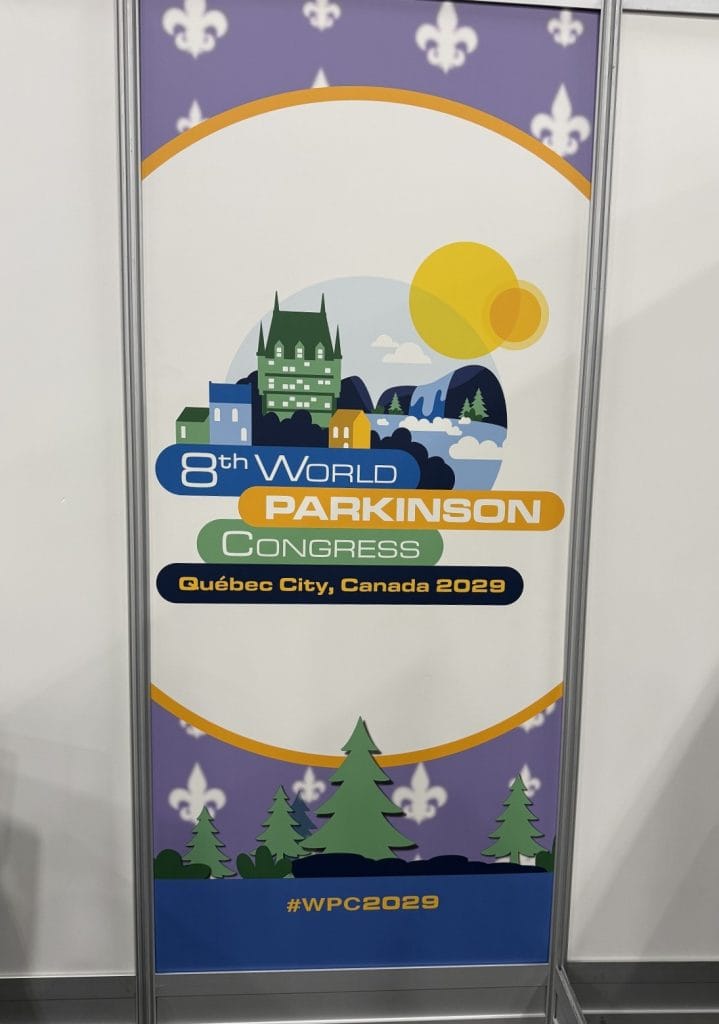
My first time at the WPC definitely has me wanting to come back. See you in Quebec City in 2029!
Thanks for reading all the way down to here. Now it’s your turn to add a comment or thought below.




Thanks for your updates and great insights about the WPC! Congratulations on your hike. Sounds like a great success.
Since I was unable to attend, reading your posts made me feel like I was there!
Thank you, Susan. Perhaps 2029 will be your WPC debut! I hope so.
Wow!! What a crew on the hike!! Sounds like a great success all around. Sending love from Japan!🇯🇵
Hey, thanks! We met lots people who do good things for the world. Safe travels!
This whole conference experience sounds like it was amazing! And I can’t believe self driving cars are all over Phoenix😀 Very cool!
The car experience was surreal!
Hi Colleen!
We met at pickle ball on Wednesday at WPC. You are a very active woman. Thank you for your notes on the different talks you attended!
Love,
Anja
Anja, I remember you and I enjoyed our 8-minute game as we all tried to avoid the “dead spots” on the court. 🙂 Hope our paths cross again in the future.
Amazing! I just did a hike and climb at Papago park! That must have been HOT!
Actually, Jesse, the weather gods smiled on our group — sunny and in the high 70s F. Of course, going at 6 a.m. definitely helped! Hope you enjoyed the park as much as we did.