
What to say when someone has Parkinson’s
“You don’t look like you have Parkinson’s.”
Six years out from diagnosis, I hear that said occasionally when the subject comes up. My first thought usually is, “Phew! I still can successfully hide this disaster from others.”
In certain settings I try to keep my Parkinson’s from being a distraction.
I always appreciate the comment and I view it as kind. To their point, when my medications are “on” and keeping my tremors on the down low, I do look pretty normal (whatever normal looks like).
But my next thought is, “If only they knew.”
What’s not seen
Parkinson’s effects go beyond the visible. You may easily notice a person’s slow movements, a leg that won’t behave, or a shaky hand that doesn’t let food stay on the fork very long. But many PD symptoms are more than skin deep.
A while back, I made a list of common Parkinson’s symptoms for a presentation I gave at a support group.
So many to choose from! Only, you don’t get to choose.
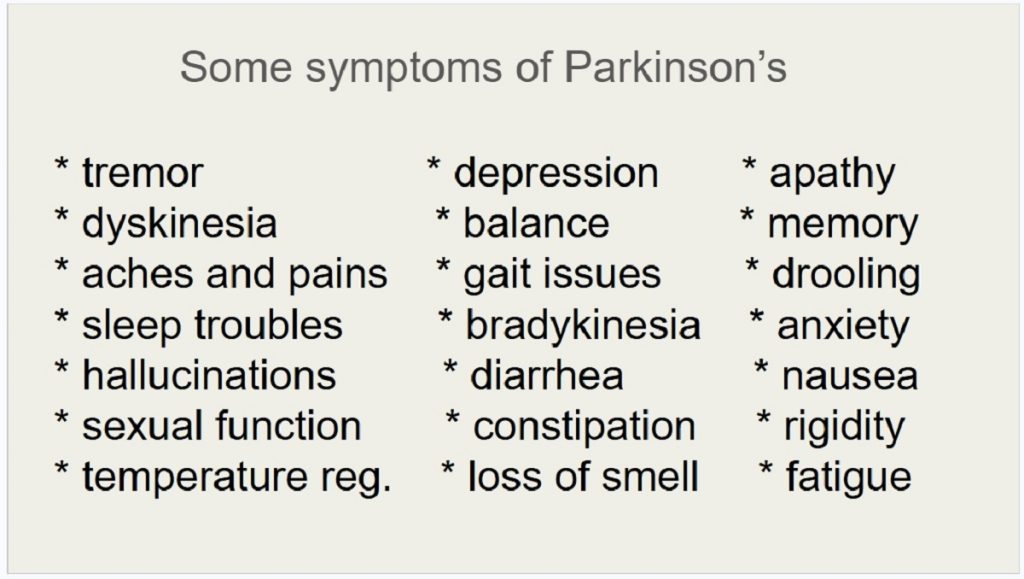
The list is a sobering picture of what might show up in someone’s future. That includes my own!
The observable symptoms are obvious — like the stiff arm and slow movement that made it a really bad day for me on the pickleball court recently. I couldn’t get the ball to go straight. My right arm would jerk suddenly as I served.
And I kept hitting the ball with the top of my paddle, indicating a longer reaction time.

Thanks a lot, bradykinesia, for slowing down my joint and muscle movements.
However, some of the invisible symptoms can be far worse than the ones that show.
- Memory and cognitive impairments are closely tied to Parkinson’s disease.
- Depression and anxiety are common even in people who never had dealt with mental health challenges before.
- Constipation and other GI issues are constant plagues for more than half of PD patients.
- I’ve heard of hallucinations, and nighttime dreams being acted out to the point that partners fear for their safety.
Saying it well
Here are some ways well-intentioned people can respond with kindness when someone tells them they have Parkinson’s.
For starters, avoid pushing for details about their health. Also, refrain from giving advice.

Statements like the following will lift the conversation and send it soaring into a clear blue sky.
“You look good. Is that how you’re feeling too?
“I’d like to hear more about your Parkinson’s sometime. Would that be all right?”
“I’ve heard it affects people differently. What’s your experience been?”
“I’m so sorry you’re dealing with this. Is there something I can do to make it easier for you?”
It is safe to assume most people who live with PD are struggling in some way — even when they don’t “look like” they have Parkinson’s disease.
Let’s all spread a little kindness.
Have you had good experiences talking about Parkinson’s with others? An awkward one? Do share, in the comments below!


